


Garden Lighting in the Highlands: What Actually Works
The Challenge of Garden Lighting Up Here
When people ask me about lighting their gardens in the Highlands, they’re usually thinking about summer evenings — long daylight and romantic ambiance. But that’s only half the story.
The real challenge with garden lighting in the Highlands isn’t summer at all. It’s the complete opposite. In December and January, we get about seven hours of daylight. If you want your garden to work year-round, you need lighting that works with that reality, not against it.
I’ve learned this through 30 years of designing and building gardens here. The gardens that look best when lit at night are the ones where lighting was part of the design from the beginning — not added as an afterthought.
Light and Shadow Work Differently Here
Highland light is unique. Even in summer, the angle of the sun is never as high as it is down south. This means shadows behave differently. A tree that would cast deep shadows in Surrey might barely cast a shadow here.
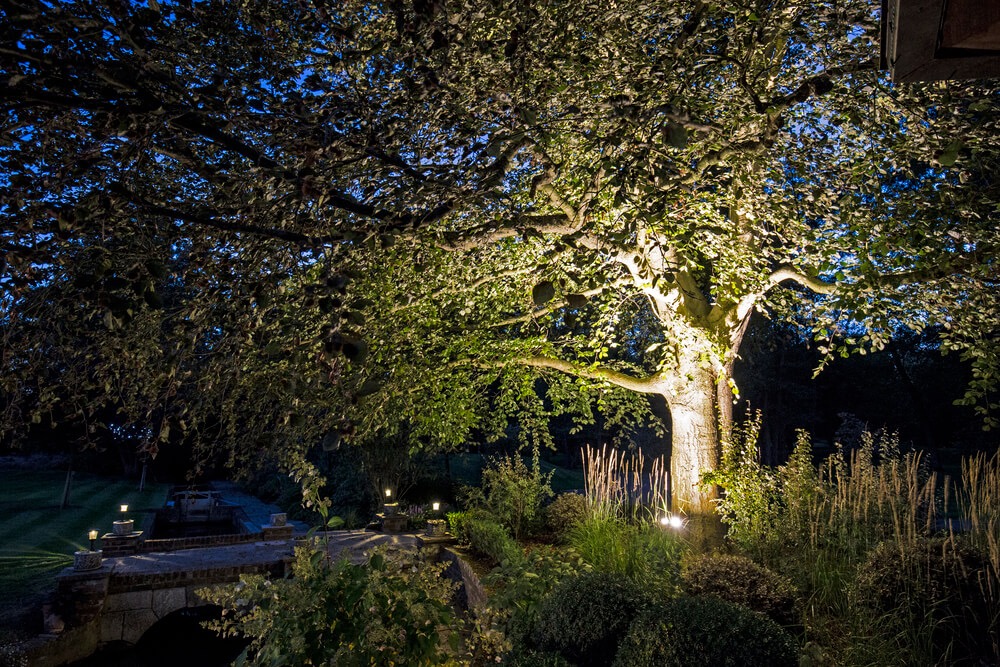
When you’re thinking about uplighting trees — directing light upward from the base — you need to understand your specific site. The textured bark of a birch tree looks beautiful when lit this way, but only if you’ve placed the light correctly for your garden’s conditions.
I always recommend visiting the site at dusk, at different times of year, to understand how light naturally falls. That tells you where to place lighting for maximum impact.
Practical Lighting That Lasts
Over the years, I’ve seen people install fancy lighting systems that fail within a season. Here’s what I’ve learned works in Highland gardens:
Pathway lighting — Solar-powered pathway lights do work here, but you need to choose them carefully. LED solar lights are reliable, and in summer they charge well enough. In winter, they’re more subtle, which is actually fine because you’re using your garden less anyway. The key is good quality — cheap solar lights fail quickly in Scottish weather.
Spotlighting features — If you have a focal point — a sculpture, a water feature, an architectural wall — spotlighting draws attention to it beautifully. But the light needs to be weather-resistant. Wind and rain are relentless here. Cheap fittings corrode and fail.
Festoon and string lights — These work wonderfully for summer entertaining, but they’re not permanent solutions. I think of them as seasonal — put them up for summer gatherings, take them down before autumn storms hit. They create atmosphere without pretending to be something they’re not.
What I Actually Recommend
After 30 years, I’ve narrowed down what genuinely works in Highland gardens:
For permanent installations: Invest in quality LED lighting with proper weather sealing. The upfront cost is higher, but it lasts. I’ve seen cheap outdoor lighting fail in two seasons; good quality lasts 10+ years.
For structural lighting: If you’re lighting walls, fences, or built features, uplighting and downlighting (light from above and below) creates depth and drama. This works particularly well with natural stone, which our Highland gardens often feature.
For living elements: Tree lighting needs to be subtle and responsive to the actual structure of your trees. Don’t assume every tree needs uplighting. Sometimes the best approach is to light what’s around the tree rather than the tree itself.
For pathways: Good lighting makes gardens safe and usable in winter months. This is about function as much as aesthetics. A well-lit path that’s clearly defined is both beautiful and practical.
Integration With Design
Here’s what I think matters most: lighting should feel like part of the garden design, not an addition to it.
When I’m designing a garden, I’m thinking about how it will be used at different times of year, in different light conditions. If lighting is going to be part of that experience, it needs to be integrated from the start — in the placement of trees, the positioning of seating areas, the choice of materials.
A garden lit well is a garden that’s been thought through properly. It’s not about having the most impressive lighting system. It’s about having lighting that makes sense for your garden, your site, and how you actually use the space.
The Highland Advantage
One thing I’ve come to appreciate: we have genuinely beautiful natural light in the Highlands, even with our shorter winters. The quality of light here — the way it hits stone, how it reflects off water, the soft quality even on cloudy days — is distinctive.
Good garden lighting should enhance that, not fight it. It should work with our landscape, not pretend we’re somewhere else.
If you’re thinking about adding lighting to your garden, I’d recommend starting with a site visit at different times of day and year. Understand how light naturally moves through your space. Then add lighting that amplifies what’s already beautiful about your site.
That’s the approach that’s worked for me across hundreds of gardens, and it’s what I’d recommend to you.
If you’d like to discuss garden lighting for your space, we offer site consultations across the Highlands. Get in touch to talk through how lighting could enhance your garden.
Contact us or call Ernest on 01997 477319